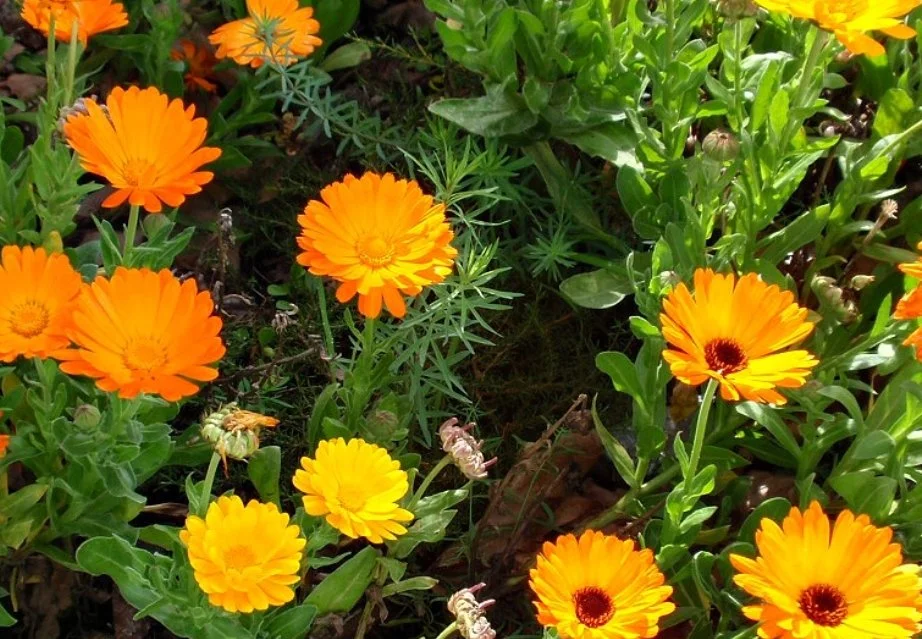
How does Calendula work? How does this little orange flower support the body to heal cuts, scrapes and wounds while preventing infections?
In homeopathic medicine we can’t connect how a plant grows or what it looks like with what it does. It is simply empirically proven that it works in a certain way.
But, with Anthroposophic medicine, the attempt is made to connect the phenomenology of a substance with its effect, to understand why it works. This means… the way something LOOKS or SMELLS or HOW IT GROWS or WHAT COLOR it is can help us to understand WHY it works.
An advantage of this approach is that it enables us to assess the medicinal effect of a new substance without trying it out in a homeopathic proving.
Calendula has abundant growth energy. Its growth is lush and moist and the flowers come quickly and keep arriving into November. They are an intense orange, almost fluorescent. Although it is an annual, it re-seeds easily and comes back each year. It can grow in poor soil because it has so much innate vitality!
Thus it contains a life energy which helps damaged tissue to remain vital and knit together without any infection.
But there is more to it. When you SMELL the plant, its background scent is not exactly pleasant. In fact, you may find it smells SOMEWHAT ROTTEN! Yes, it smells decayed underneath the pleasant scent, even though it looks perfectly lovely and alive and full of vitality.
Because…Calendula contains an image of the illness it is used to treat, as well as the cure! The vibrant orange flowers and other parts have resins that preserve tissue against deterioration. It’s also interesting to note despite the lush growth, the numerous flowers stop overgrowth, preventing it from getting “out of control”.
Thus, Calendula shows the illness of excessive, “inflammatory” growth and the remedy of proper containment, establishing healthy boundaries again.
10% Calendula gel can be an important addition to your natural healing cabinet.